


"Bearing Witness: On Animal Suffering": An essay by Rebekah Humphreys (Keywords: Animal-Industrial Complex;Objectification; Speciesism;Institutional violence;Moral blindness;Animal liberation)
From The Philosopher, vol. 113, no. 2 ("Crossing the Floods")
You can order the digital copy of this issue and all previous issues here.
If you enjoy reading this, please consider becoming a patron or making a small donation.
We are unfunded and your support is greatly appreciated.
I. Hidden from view
Many people will be familiar with the distinction between hearing and listening, with hearing often considered as a more passive process than listening. I have come to think of looking and seeing as somewhat analogous, with looking being more passive than seeing in the sense that looking does not require us to do anything as such. Seeing, on the other hand, requires engagement and a consideration of possible responses. Though this passive/active distinction is oversimplified – since all perception involves filtering and interpretation – it remains useful for highlighting the contrast between merely looking and truly seeing.
Indeed, we may think of seeing as not simply a sensory activity, but a moral one, linked to intentions and agency. Insofar as emotions influence our responses, seeing can also involve empathy – not just seeing what is ‘on the surface’ but engaging with something deeper, including a creature’s suffering by imagining it as if it were one’s own. Such empathic seeing goes beyond mere observation, enabling us to imagine the suffering of another creature even when we are not actively witnessing it. In this way, we may refer to, think about and reflect on a creature’s suffering in our everyday lives, which can in turn influence the choices we make. The act of seeing is thus a philosophical practice, involving interpretation and meaning-making, especially with regard to suffering.
This essay considers the philosophical and moral dimensions of the act of seeing in relation to animal suffering. What does it mean to see the world as one inhabited by billions of suffering animals? How do we bear witness to their suffering? The focus here is on avoidable animal suffering, the extent of which, as Jacques Derrida claimed, is almost unimaginable. The number of animals currently suffering for reasons related to profit is hard to comprehend. Compassion in World Farming estimates that, globally, around 95 billion animals are used in factory farming each year, while Cruelty Free International reports that approximately 192 million animals are used in experimentation worldwide. And these are just the ‘countable’ animals, which do not include those considered ‘by-products’ of the respective industries.
On the one hand, people do not want animals to suffer for human purposes; on the other hand, this suffering is, to a large extent, overlooked or even denied.
We may here use the term ‘Animal-Industrial Complex’ (A-IC) – first used by Barbara Noske in Humans and Other Animals (1989), and most recently by Gwen Hunnicutt, Richard Twine and Kenneth Mentor in Violence and Harm in the Animal Industrial Complex (2024) – to refer to the complex web of powerful corporations, institutions, and conglomerates that profit from the use, destruction, and consumption of animals, influenced in part by capitalist norms that drive endless growth and consumerism. The A-IC thrives on the back of animal suffering, both the consumption of non-human animals and the products derived from their exploitation. Under A-IC, animals experience at least three kinds of suffering: physical suffering (pain and injury, for example), mental suffering (in the form of stress, frustration and anxiety), and emotional suffering (such as grief and loneliness).
Despite this, there is a certain ‘banality of evil’ that has come to be associated with such extensive animal suffering. This phrase was first used by Hannah Arendt in relation to the Holocaust and, in particular, the crimes of Adolf Eichmann who felt no responsibility for his actions, claiming to simply be ‘doing his job’. In Eichmann and the Holocaust, Arendt argued that, despite his horrifying crimes, Eichmann was not inherently evil: ‘The trouble with Eichmann was precisely that so many were like him … they were, and still are, terribly and terrifyingly normal’. When Arendt used the phrase ‘banality of evil’, she was emphasising that evil is not committed by monsters, but by people who blindly follow routine, who fail to reflect on what their actions mean in a moral sense and who fail to link their routine jobs or procedures to the suffering they cause. What their actions mean for others has, in this way, been willingly or unwittingly ignored. As she claims of Eichmann, ‘It was shear thoughtless that predisposed him to become one of the greatest criminals of the period’.
The ongoing suffering of animals – which for the purposes of this essay will mean the suffering of animals within the A-IC – can be seen to manifest a similar banality of evil. In this context, profound harm can be perpetuated through unreflective participation in institutional processes (including bureaucratic ones) that normalise violence against sentient beings. It can also occur through habitual, consumer, and cultural practices that do not question the status quo.
However, people, for the most part, do not ‘support’ animal suffering. But insofar as we cannot separate ourselves from the tentacles of the A-IC, we are complicit in practices that serve to make a profit on the back of it. Human-caused animal suffering has become so entrenched in modern society – from the clothes we wear to the words we use to describe animals used in commercial practices such as factory farming and animal experimentation – that we often fail to even register it.
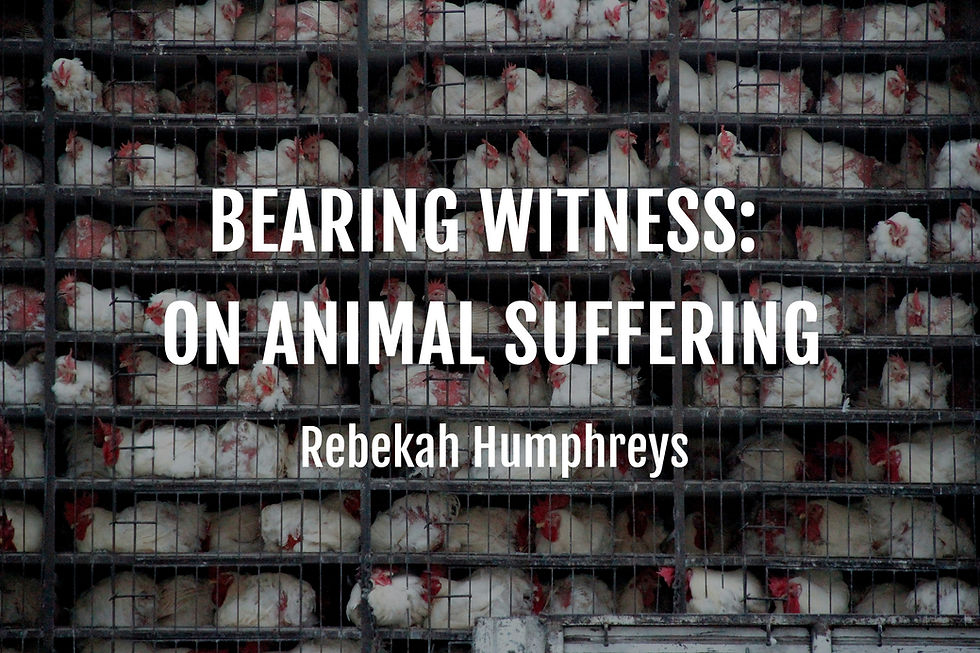
Within the A-IC, this everydayness of animal suffering is deeply problematic, mainly for the animals themselves who, to a large extent, remain literally hidden from view. In the case of factory farming, they are ‘housed’ in overcrowded conditions within large sheds or in the case of animal experimentation, within cages in laboratories, both of which deprive the animals from living a life natural to their own kind. This hiddenness of the suffering of billions of animals is in part what makes it so appalling. To a certain extent, hiddenness itself fosters a lack of acknowledgement of their plight, with many people remaining unmoved or at least removed from seeing animal suffering in a direct way.
Profound harm can be perpetuated through unreflective participation in institutional processes (including bureaucratic ones) that normalise violence against sentient beings.
We may, of course, see some farm animals in the countryside, and some of the animals we encage are observable to us, including those in zoos and petting stations. But what we do not see are the animals living in the severe confinement and darkness of the factory farm. Ironically and tragically, these animals are in our supposed ‘care’. As their caretakers, we are responsible for the quality of their lives, yet they endure lives of suffering for which we alone are to be blamed.
Indeed, the majority of animals within the A-IC are concealed, as the exposure of their suffering is distressing for the human observer. Of course, media images by campaigners show us what really happens to animals beyond the sanitised narratives of big businesses, even if we cannot see the animals directly, but only in a mediated way. But even here, we cannot simply passively look, but actively see in a way that recognises the sheer brutality embedded in the everyday treatment of animals. It calls for a critical engagement and moral awareness capable of challenging our everyday societal norms, habits, and ways of life that allow such suffering to persist.
II. Compartmentalisation
There is a complex set of psychological factors that prevent us from recognising our complicity in this. Those who seek to deny animal suffering literally avoid looking, resisting the demand – both emotional and moral – imposed by the reality of animals’ lives. As Elisa Aaltola claims, ‘We know that, after looking, we shall not be the same’ (I take it that ‘looking’ here is akin to what I mean by ‘seeing’). The now familiar phrase attributed to Paul McCartney also comes to mind: ‘If slaughterhouses had glass walls, everyone would be a vegetarian’. To see what happens to animals, and to engage emotionally with their plight, would potentially lead to widespread opposition to practices that render animals disposable.
The narrative we tell ourselves about farm animals is also one that abstracts them from their own individuality, reducing them to a mere instance of their species. Individual sheep are taken to belong to the category ‘Sheep’ and cows, to the category ‘Cow’. Their existence is thus subsumed into a collective category such that their individual lived experiences are excluded from our conceptions. Indeed, the language used to describe animals within the A-IC objectifies them to the extent that they become unrecognisable as animals with their own subjectivities. For example, animals are referred to as ‘stock’. The pronoun ‘it’ renders them as inanimate objects. We buy ‘meat’, not dead animals; we eat ‘beef steaks’ or ‘pork chops’, not the once-alive individual cows and pigs.
To see what happens to animals, and to engage emotionally with their plight, would potentially lead to widespread opposition to practices that render animals disposable.
The living subject, as well as her killing, blood, and suffering, is starkly absent from most people’s view, from their consciousness and consequently, their moral considerations. As Dinesh Wadiwel claims, ‘The image that one finds on some butcher shop signs, or the side of refrigerated trucks, featuring a smiling cartoonised cow or pig slicing at their own bodies with a knife, attests to the casual way in which everyday violence is discursively hidden from view’. While such images are common in the marketing of meat products, they hide and even trivialise the brutal violence endured by animals. Such portrayals enable a form of distancing, particularly of a moral kind.
These factors may well be seen as perpetuating an extreme form of cognitive compartmentalisation, whereby moral judgments are not applied to our actions as they would be outside the context of A-IC. Indeed, if we, outside of certain institutional contexts, subjected animals to the same kinds of suffering that they endure within them – including in animal experimentation and factory farming – even for what might be seen as important human benefits, our actions would probably be regarded as morally repugnant. We might imagine here a scenario in which a scientist conducts painful experiments on hundreds of animals in her own home, encaging them for years whilst performing agonising procedures on them. She rationalises that her actions could lead to a discovery for human health. While we may understand her reasons for conducting the experiments, we may well be appalled by her actions. Yet within an institutional context, those same actions might nonetheless be condoned.
Such extreme compartmentalisation may foster desensitisation: an unresponsiveness to the suffering of animals within certain institutions; suffering that would evoke horror were it inflicted outside of them. Notwithstanding the complex power relations that form part of the A-IC and contribute to its continuance, such psychological habits often circularly bolster an ideology that accepts such suffering as the norm and frames it as somehow permissible, yet, at the same time, keeps it below our radar, unseen and unthought of. The results continue to be catastrophic, not just for animals in terms of their welfare and interests, but also for humans who are negatively affected by the practices of the A-IC, including its disproportionate use of natural resources.
III. Objectification
There are aspects of the injustices we inflict on non-human animals today that have their parallels in human history. In fact, the concept of speciesism, well known in the animal liberation debates, is based on an argument by analogy with racism and sexism and refers to the discriminatory treatment of nonhuman animals on the basis of species membership. Speciesism continues to play a key role in explaining the injustices done to animals within the A-IC. Indeed, the A-IC’s treatment of animals has clear analogies with the socially sanctioned racism and sexism of the past. This is not to suggest that institutionalised forms of discrimination no longer exist; on the contrary, they continue to manifest across societies. Rather, it is meant to highlight that the oppressions of humans and other animals stem from shared cultural and ideological frameworks that render certain exploitative practices as somehow acceptable precisely because they are perceived as ‘the norm’.
The objectification of animals not only obscures the moral reality of their suffering but also facilitates a form of institutionalised moral blindness.
Objectification may be considered as a mechanism that connects various forms of discrimination across species and across histories of human oppression. Similar to human forms of oppression, objectification reduces that which is oppressed from a living, sentient being to something that can be used at the will of humanity (or more precisely, a privileged sector of humanity). And insofar as those beings who are oppressed are viewed as objects and consumables and thus literally commodified, their exploitation is considered permissible. In this sense, objectification is a feature that links all oppressions.
Similar to some of the worst human abuses across history, through detached, mechanised violence, animals within the A-IC are conceived as abstractions of their own existence; their identities and agency are systematically stripped away through force and manipulation. Denied a life natural to their own kind, their commodification conceals their subjectivities; they are shackled, confined, transported in overcrowded trucks, forced to live in their own filth, poisoned, subjected to cruel and futile experiments, and ultimately herded into slaughterhouses. Such objectification not only obscures the moral reality of their suffering but also facilitates a form of institutionalised moral blindness whereby systemic violence is rendered cognitively and morally invisible.
IV. Unveiling
The act of seeing nonhuman animals, then, has a moral dimension, serving to unveil hidden oppressions. To challenge the objectification of animals (including humans), it must first be brought into view and made visible to the public. It is, of course, in the interests of the A-IC to use a range of methods to hide the suffering of animals from public view. And yet this suffering has been and continues to be uncovered by animal charities, investigative journalism, and media campaigns, all of which expose the realities of factory farming, animal experimentation, and other exploitative practices to a wider audience. This ongoing exposure means that many people do have opportunities to see what happens to the animals within the A-IC.
People can be morally repulsed by animal suffering, yet display no reservations about consuming animals or using animal products. This reveals the fundamental inconsistency between our general acceptance of consumptive treatment of other animals and our professed aversion to the suffering involved in such treatment. On the one hand, people do not want animals to suffer for human purposes; on the other hand, this suffering is, to a large extent, overlooked or even denied. This moral dilemma is not easy to solve. It is a complex issue that directly concerns the current moral paradigm which accepts animal suffering on a massive scale, in the sense of it being a normalised part of society and so entrenched in our everyday practices that our involvement and support of it (whether directly or indirectly) is somehow thereby assumed to be permissible.
The moral dissonance involved here is not a simple contradiction, and the drivers for it are numerous and systemic. But some can be overcome on an individual level. For instance, the distancing of non-human animals from our moral viewpoints can be countered through imaginative reflection and empathetic engagement with the reality of animals’ lived experiences. Bringing such violence to the surface and seeing it for what it is, beyond that which it is marketed as, can render it hyper-visible (recall, for example, Wadiwel’s description of the image of an animal slicing her own body mentioned earlier).
Political enfranchisement of non-human animals is vital to ensuring that their interests are properly represented.
Insofar as the act of seeing brings injustices to the forefront of people’s consciousness, the use of imagery (which would here include photographic and video evidence) to depict the suffering of animals is justified. Along with investigations into the often-secretive commercial practices that use animals, factual knowledge, anchored in ethical arguments, also enables us to see animals. Such knowledge is essential for making people aware of the problematic narrative of happy animals roaming free and the welfare-washing that prevents consumers from making informed choices.
This is not to say that ‘seeing’, on its own, is sufficient to change entrenched systemic and exploitative practices. Rather, it implies that ‘seeing’ is part of a process of change at the individual level and has a political dimension, as it plays a role in revising beliefs and attitudes, as well as habits and choices. This is part of what Aaltola means by ‘after looking [which I take to mean actively seeing], we shall not be the same’. Accepting our complicity, and thus our responsibility, forces our hand, so to speak, to confront the moral reality of what we support, to bear witness to animal suffering instead of turning away from it.
Despite potentially overwhelming feelings of despair regarding the current realities of animal use within the A-IC, there are things we can and should do to challenge these practices. Historical examples of humans overcoming entrenched systems of oppression are instructive here, with the suffragette movement and the abolition of slavery serving as two prominent cases. Animals’ significant interests are persistently undermined by the A-IC, and this is precisely why political enfranchisement of non-human animals is vital to ensuring that their interests are properly represented; an enfranchisement which begins via seeing as an engaged act that reveals the stories of animals, brings their objectification to the surface and within public view. Such engagement is vital in prompting political and moral responses.
However, such responses are not limited to issues of animal ethics. They also address the broader question of humanities and what it means to be human. In the context of this essay, this general question extends to what it means to be a moral being in a world with billions of suffering animals, as well as to who we want – or ought – to be in relation to other animals. As with injustices against certain groups of humans, engaging with these questions requires us to not merely look but truly see animals, critically reflecting not only on our treatment of other creatures, but also on ourselves: our attitudes, values, and practices as moral agents.
Rebekah Humphreys is a Senior Lecturer in Philosophy at the University of Wales Trinity Saint David (UWTSD), Carmarthen, Wales, UK, where she is co-Chair of the UWTSD’s Research Ethics and Integrity University Committee. Her work spans animal ethics, environmental ethics, and critical animal studies, and she is particularly interested in the intersections between ethics, ethology and psychology. She is the author of Animals, Ethics and Language: The Philosophy of Meaningful Communication in the Lives of Animals (Palgrave, 2023), Animal Studies and Philosophy (2026, forthcoming), as well as a range of peer-reviewed articles in animal ethics.
First published online on 21st June 2026
If you enjoyed reading this, please consider becoming a Patreon member or making a donation. The Philosopher is unfunded and your support is greatly appreciated.


