


"When ‘humanity does not rise in protest’, what can philosophy do?": An essay by Meena Dhanda (Keywords: Dissent;Social Justice;Caste; Settler Colonialism;Authoritarianism;Public philosophy)
If you enjoy reading this, please consider becoming a Patreon member or making a donation. The Philosopher is unfunded and your support is greatly appreciated.
The space for dissident voices to speak out on vexing socio-political and philosophical issues has noticeably shrunk. Redundancies resulting from the marketisation of higher education, the shrinking of the job market for marginalised groups, and the rise of authoritarianism is silencing voices across the world. We live in rescue mode from one ‘social emergency’ to the next. Can doing philosophy dismantle hurdles to articulating dissent? Can it shine a light on the complicities of the privileged?
In her powerful book New Radical Enlightenment: Philosophy for a Common World, Maria Garcés writes that the ‘decisive fact of our time’ is that ‘we know a lot and yet we can do very little. We are both enlightened and illiterate’. In the desperation to remain relevant, we succumb to the demand to produce ‘solutions.’ But she insists, ‘Solutionism is the cover for knowledge that has lost the power to make us better, both as individuals and as a society.’ We need to reconnect knowledge to emancipation and fight the ‘battle against credulousness’, using philosophy as our weapon. As we witness the parallel ballooning of two dangerous ideologies in Zionism and Hindutva, both shored up by violent state machineries, we cannot but embrace the urgency of weaponizing the power of critical thinking.
Nearly a century ago, the much revered champion of Dalit rights B.R. Ambedkar resolutely refused on request to change the text of his speech Annihilation of Caste, originally meant to be delivered as a Presidential Address to the Jat Pat Todak Mandal (Organisation for Undoing Caste Pride).
The jurist and economist, who led the drafting committee of the Indian constitution, wrote that ‘Criticizing and ridiculing people for not inter-dining or inter-marrying or occasionally holding inter-castes dinners and celebrating inter-caste marriages, is a futile method of achieving the desired end. The real remedy is to destroy the belief in the sanctity of the Shastras [ancient instructional treaties or texts in specific fields of knowledge’ (emphasis added)
The Mandal’s handling of the problem of lack of inter-dining and non-acceptance of inter-caste marriages is critiqued by Ambedkar as superficial. We might say it is their ‘solutionism’ that Ambedkar is opposed to. ‘Criticising and ridiculing’, ‘occasionally’ holding inter-caste dinners and ‘celebrating’ inter-caste marriages, are all quick fixes, relying on a demonstrative effect to succeed, and not methodically conceived long-term remedies for the disease of casteism. That is, the psychological terrorism inflicted by the Mandal to merely ‘manage change’ is futile, because real change requires a greater and deeper reckoning with casteism. That does not mean, though, that the end of erasing caste distinctions in marriage is faulty. Rather, the means chosen by the Mandal – the how of conducting and facilitating inter-caste marriages and commensality – are questioned by Ambedkar, not that inter-caste marriages and commensality are futile. In other words, he is opposed to the solutionist way the Mandal approached the problem, but in favour of creating conditions in which people could and would choose to inter-marry across caste, and feel free to inter-dine. In a society accustomed to turning a blind eye to the debilities of caste divisions, creating conditions for caste border crossings would require an overhaul of a form of social living. For Ambedkar, that overhaul was spearheaded by instituting robust legal rights for the socio-political upliftment of Dalits, but towards the end of his life, his conversion to Buddhism suggests that legal measures may not go all the way to transform social relations, and that a socio-religious change is also necessary.
Many have relaxed into systems of caste and class privilege and routinely benefit from keeping the mechanisms of the embedded exploitation hidden from critical scrutiny.
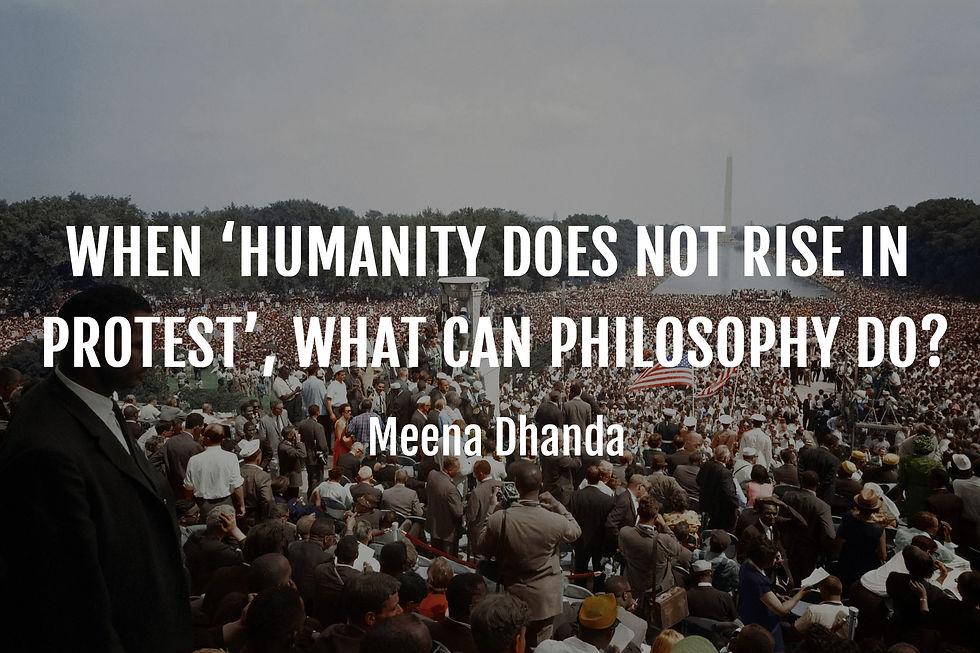
In a plenary session of the Round Table conference on 19th January 1931 discussing safeguards for the Depressed Classes in the future Constitution, Ambedkar charged thus: ‘India is a peculiar country and her nationalists and patriots are a peculiar people. A patriot and a nationalist in India is one who sees with open eyes his fellowmen treated as being less than men. But his humanity does not rise in protest. He knows that men and women for no cause are denied their human rights. But it does not prick his civic sense to helpful action. He finds whole class of people shut out from public employment. But it does not rouse his sense of justice and fair play. Hundreds of evil practices that injure man and society are perceived by him. But they do not sicken him with disgust. The patriot’s one cry is power and more power for him and for his class.’
Blindness to the inequities of caste in everyday life has not ended, nor has this lack of will to rise in protest, this shrunken civic sense, this deadening of the sense of justice, this apathy to the injury of others. Many have relaxed into systems of caste and class privilege and routinely benefit from keeping the mechanisms of the embedded exploitation hidden from critical scrutiny.
Justice remains elusive to the sufferers of caste atrocities mainly because caste privilege is normalised in everyday social interactions and permeates all institutions. On the one hand, caste and capitalism work together to incentivise the use of birth-ascribed occupations to secure employment, and on the other, those who seek to transition out of inherited exploitative occupations are met with atrocities such as humiliation, brutal physical assault, caste-based sexual violence, and murder. Further, racializing tropes are deployed to degrade, humiliate, and materially deprive the poor of their homes. In the name of urban development, not poverty but the presence of the poor is obliterated. Desperate illegal manoeuvres committed by the poor are dealt by law enforcers differently compared to the calculated overreach of the middle classes. Settlements of the poor, labelled ‘encroachments’ in a criminalizing language, are razed to the ground. At the same time, the high-rise buildings of the middle-classes which systematically and deliberately flout building permissions and planning regulations remain standing. Capitalism’s new frontiers reek with corruption.
The popularity of the term ‘bulldozer Justice’ to refer to the use of bulldozers to destroy homes labelled as illegal is the most extreme example of this approach. The frequency with which bulldozers are unleashed upon Muslims who protest state excesses and are termed ‘rioters’ is telling.
Alongside the unchecked perpetuation of privilege, the enormity of disasters facing our world with few taking any responsibility for the degradation we are causing should make us revisit the point of doing philosophy. The relentless violence in the Middle East, coupled with the steady rise of right-wing populist movements, within India expressed as an anti-Muslim, anti-Dalit wave of hatred, an unending onslaught accompanying a rapacious capitalism, understandably drains the will to fight back or look for lasting solutions to our planetary crises. To succumb to these feelings, though, would defeat the purpose of self-scrutiny.
As we see Gaza razed to the ground by the settler colonial state of Israel, we remind ourselves that whilst modern Tel Aviv was built on several Palestinian villages, on a smaller scale, the Le Corbusier-designed Chandigarh also displaced poor inhabitants to create a modern city. The ‘planetary entanglements’ that make some lives simply dispensable, surface in distinct forms in different regions of the world, as Achille Mbembe explains.
We need to reconnect knowledge to emancipation and fight the ‘battle against credulousness’, using philosophy as our weapon.
To understand the entrenched injustice of the modern settler colonist project of Israel, it is crucial to focus on work, land, and the workers. Prior to October 7th, 2023, between 170-200,000 Palestinians worked in Israel, most with work permits, living in the occupied West Bank. After October 7th, nearly all Palestinian workers were fired, their work permits revoked. The economic damage in construction and agriculture, where most Palestinians had been employed was evident. With building projects on hold, the ‘solution’ devised by Israel was to import workers from Asia, in particular, India and Thailand.
Thousands of educated unemployed from India were ready to risk their lives and be recruited as construction workers in a war zone. The myth of personal economic uplift is only a fig leaf to cover the hopelessness that drives desperate men and women to become part of cross-border migrant labour. Israel has developed close economic ties with India. A flagship spyware, Pegasus, developed by an Israeli surveillance firm NSO Group was used to plant incriminating documents in the mobile phones of Indian activists, a spyware the firm claims is strictly sold to government clients only. According to news reports, WhatsApp confirmed that several journalists, activists, lawyers and academics were targets of surveillance and it had sued this firm accusing it of helping government spies break into the phones of citizens.
Infosys, an Indian company owned by the father-in-law of former UK Prime Minister Rishi Sunak, was contracted by BP for data management, facilitating BP’s oil exploration in Gaza waters that Israel licensed shortly after the October 7th catastrophic events.
All this while Israel has intentionally decimated the Palestinian economy. Increasing restrictions on Palestinians limit their access to raw materials and seek to eliminate them from economic life. The routine destruction of Palestinian olive groves is aimed at undercutting Palestinian self-determination, confirming the thesis that Zionism is a program of land acquisition.
A striking image, amongst many in an incisive film by Adam Kossoff – In the Loop of History – is of sprinklers over young plants in an agricultural field, a documentary footage telling us in a voiceover, ‘They came to a dessert, it has been made to bloom.’ This is an enduring myth of settler colonialism. It erases the fact that there was an ecosphere before the occupation, the farmlands of the Palestinians which the Israelis incorporated or destroyed and continue to do.
'If philosophy ceases to be public today, then we must develop a guerrilla version that will make philosophy spread and appear where it is not expected'
Kossoff’s film deftly explodes this Lockean colonial myth of desert lands waiting to be mixed with the labour of industrious people. He amplifies and accelerates the swishing sound of the sprinklers, turning it into the sounds of bullets, cinematically shattering the colonial myth. We are left with the closing image of settler men floating on water with careless abandon – an image conjuring advertised proposals to develop Gaza seaside into resorts – whilst repeated incursions of armed forces continue to make lives unliveable for Palestinians.
It is instructive to reiterate a similarity between mythmaking evoked by the Zionists and by Hindutva forces. One of the myths deployed to justify everyday exploitative practices of castes is that the hierarchical caste system is a peaceful division of labour according to people’s birth-ascribed capabilities. Ambedkar exposed the fabrication of this myth in his critical work: Philosophy of Hinduism. The myths work to dull the critical sensibilities of people primed to ‘unite’ into a mass zealous defence of national patriotism.
Slogans and cliches are used to unite people divided by conflicting interests. Jake Romm explains in the case of the Zionist polity how reciting slogans is the mechanism for congealing the public into a mass. Similarly, an India divided by class, caste, and religious groupings, is rallied under slogans of ‘Hindu khatre mein hai’ – the ‘Hindus are in danger’. In both Israel and India, the fabricated enemy is the ‘vile’ Muslim. A semblance of argumentation is used by first constructing a glorified image of the culture of the past, which Muslim invaders allegedly destroyed and supplanted with their own ‘inferior’ culture. Slogans and cliches are deployed in launching an extensive exercise covering censorship of school curriculums, surveillance of university lecturers, funding of dubious archaeological research, building a sycophantic media culture, selectively promoting pro-Hindu research institutes, destroying cultural markers of syncretic Indianness and Adivasi (indigenous) cultural heritage, and most tellingly, incarcerating human rights defenders who dare to challenge the excesses of the Indian state’s violent machinery.
In our own attempt to get caste discrimination covered by the UK Equality law, we have accosted relentless opposition to the mention of the word ‘caste’, especially when incorporated within the available matrix of anti-racism in the diasporic context. The acerbity of attacks on us from the Hindu lobby becomes explicable when we read the long history of the East African origins of Hindutva in 1947 and its subsequent proliferation when it moved into British public life.
A high-level policy document of the UK government that leaked in 2025 acknowledged that ‘Hindu Nationalist Extremism (also referred to as Hindutva)’ played a part in serious disturbances between Hindu and Muslim communities in Leicester in 2022. The charge of extremism was denied by Hindu Council UK who take ‘Hindu nationalism, in its true form’ to be ‘a positive affirmation of cultural identity, self-respect, and civilisational heritage’ not a ‘threat’. Barely hidden in the Hindu Council portrayal of Hindutva as an innocuous positive affirmation of cultural identity is a co-optation of dissident voices who challenge Hindu supremacism. In hindsight, it appears that the campaign against the legislation on caste in the UK must have been perceived by Hindutva forces from the start as an obstacle in the consolidation of Hindu nationalism. Thus, we face a twin challenge: to secure legal protection for the victims of caste discrimination in the diaspora, and to rebut the fallacious charge of ‘hinduphobia’ levelled against our attempts.
If assembling reminders is indeed the task of philosophers, and aiming for justice for the aggrieved a collective goal, then philosophers ought to engage in rousing ‘the sense of justice’,
In our unfinished long-term endeavour, we have taken philosophical argumentation out of the university into the public sphere. It has been a chequered and stressful journey, but one that established what is non-negotiable for us, namely, that the battle for social justice for the caste oppressed will continue in the diaspora. This non-negotiable commitment has been our armour in the protracted struggle to get caste included in the Equality Act 2010 in the UK, and through collective support, embedded within diversity, equity and inclusion policies in institutions across the globe.
Philosophy has not yet reached its end. What this means is that the task of philosophising must continue, within or without departments of philosophy in institutions of higher education. A battle is on, and warriors for truth must protect themselves and each other. We find an echo of this thought in Marina Garces, when she says: ‘The philosophical situation, even at its most brilliant, is always fragile. If philosophy ceases to be public today, then we must develop a guerrilla version that will make philosophy spread and appear where it is not expected.’ Or as Achille Mbembe urges us to appreciate: a detailed, vivid ‘historiography of life-forms’ has the potential to contribute to the ‘theory of the threshold’, one that is born of an ‘active relation’ between different archives of the world. The old battle between theory and action, can perhaps be resolved in the words of Deleuze in conversation with Foucault half a century ago: ‘No theory can develop without eventually encountering a wall, and practice is necessary for piercing this wall’. Theorising sets internal limits on what is knowable. When practice intervenes, accosting questions of responsibility and commitment brings us to very human choices between pragmatic compromises and non-negotiable ethical limits.
A necessarily unfinished task of philosophy is ‘assembling reminders with a particular purpose’, as Wittgenstein says. If assembling reminders is indeed the task of philosophers, and aiming for justice for the aggrieved a collective goal, then philosophers ought to engage in rousing ‘the sense of justice’, repeatedly, insistently, until such time as the humanity in us recoils at the perception of ‘evil practices that injure’. We need critical self-scrutiny, situated materialist thinking, planetary connections, and the non-negotiable as an armour.
Dr Meena Dhanda migrated in 1987 from the Indian Punjab to the UK to pursue her DPhil in philosophy at Balliol College, Oxford University, funded by a Commonwealth Scholarship, followed by a Rhodes Junior Research Fellowship at St Hilda's College. She taught philosophy at the University of Wolverhampton for over thirty-two years, progressing to a Professor of Philosophy and Cultural Politics in 2018. She is the author of The Negotiation of Personal Identity (2008), editor of Reservations for Women (2008), and co-editor of Routledge Handbook of Punjab Studies (2026) besides special issue of journals, on an eclectic range of subjects, such as anti-caste thought, Dalits and religion, race and racism.
First published online 5th July 2026
If you enjoyed reading this, please consider becoming a Patreon member or making a donation. The Philosopher is unfunded and your support is greatly appreciated.


